Spring AI Session
Spring AI Session is a structured, event-sourced conversation memory layer for Spring AI applications.
Most AI frameworks store conversation history as a flat list of messages. That works for short, simple conversations — but as sessions grow, you hit a hard limit: the model's context window. The naive solution is to truncate the oldest messages, but that breaks tool-call sequences, discards coherent turns mid-conversation, and throws away context the model may still need.
Spring AI Session solves this with three ideas working together:
- Structured events — every message is a
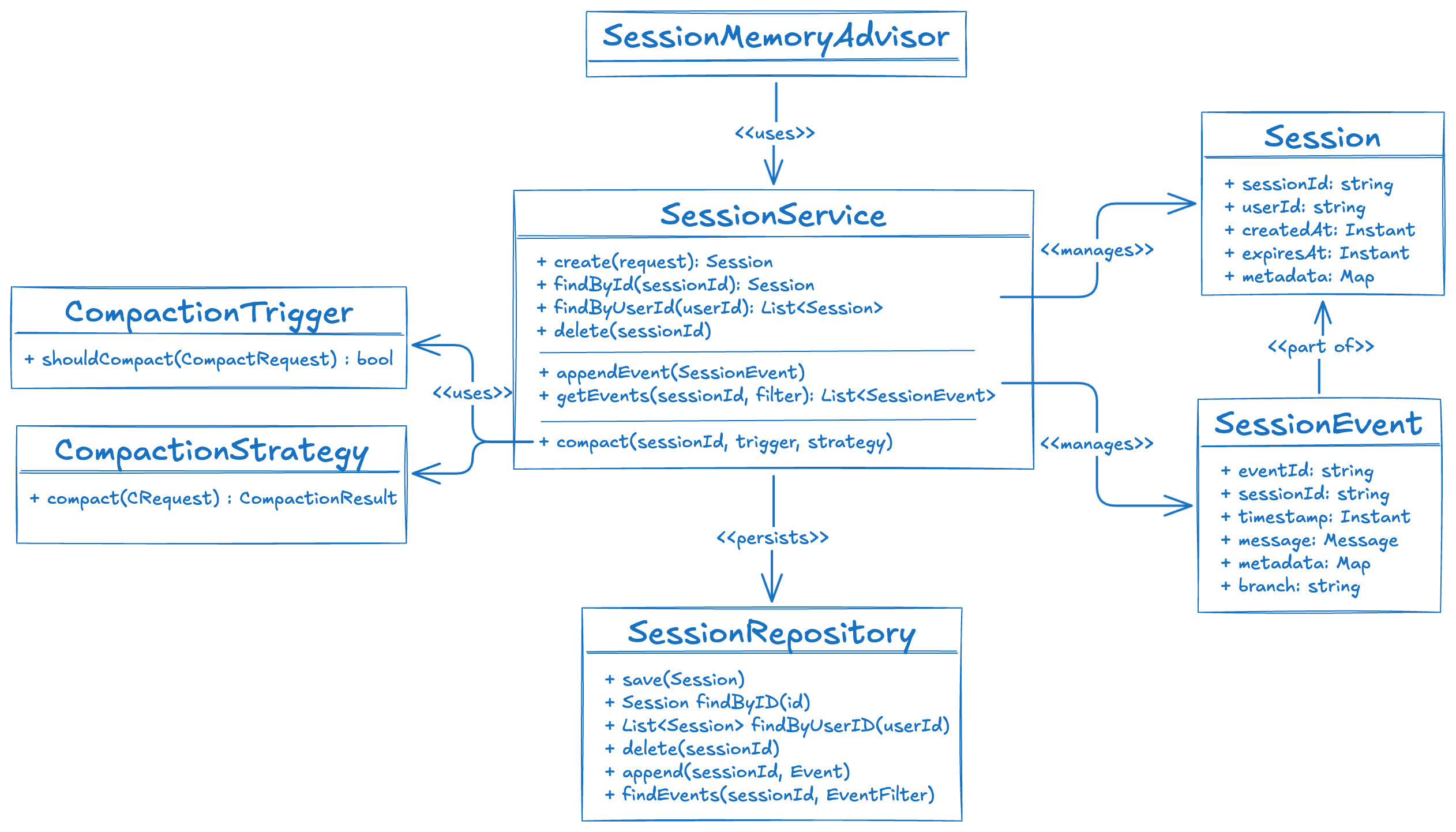
SessionEventwith a unique id, timestamp, session ownership, and optional branch label for multi-agent hierarchies. - Turn-aware compaction — configurable triggers fire when the history grows too large, and pluggable strategies decide what to keep, always respecting turn boundaries so the model never sees an orphaned tool result or a half-finished exchange.
- Persistent repositories — a clean SPI (
SessionRepository) makes it trivial to swap the default in-memory store for JDBC, Redis, or any other backend without changing application code.
Modules
| Module | Artifact | Description |
|---|---|---|
| Session Management | spring-ai-session-management |
Core SPI: Session, SessionEvent, SessionService, SessionRepository, compaction framework, SessionMemoryAdvisor |
| Session JDBC | spring-ai-session-jdbc |
JDBC-backed SessionRepository for PostgreSQL, MySQL, H2, and MariaDB |
| Session Auto-configuration | spring-ai-autoconfigure-session |
Spring Boot auto-configuration for DefaultSessionService (repository-agnostic) |
| Session JDBC Auto-configuration | spring-ai-autoconfigure-session-jdbc |
Spring Boot auto-configuration for the JDBC repository |
| Session JDBC Starter | spring-ai-starter-session-jdbc |
Spring Boot starter — one dependency for a fully wired JDBC session setup |
| Session BOM | spring-ai-session-bom |
Bill of Materials for managing all module versions together |
Key Features
- Event-sourced conversation log — append-only, immutable
SessionEventrecords wrapping Spring AIMessagetypes - Composable event filtering — filter by message type, time range, keyword, branch, last-N, or pagination
- Four compaction strategies out of the box:
SlidingWindowCompactionStrategy— keep the last N real eventsTurnWindowCompactionStrategy— keep the last N complete turnsTokenCountCompactionStrategy— keep a token-budget-bounded suffixRecursiveSummarizationCompactionStrategy— LLM-powered rolling summary
- Two compaction triggers: turn count and token count (composable with OR semantics)
- Turn-boundary safety — the kept window always starts at a
USERmessage; no orphaned tool results or split turn sequences - Optimistic concurrency — compare-and-swap
replaceEventsmakes compaction safe under concurrent requests without locking - Multi-agent branch isolation — dot-separated branch labels let peer sub-agents share one session while hiding each other's events
- Recall storage tool —
SessionEventToolsgives the model aconversation_searchtool to keyword-search the full verbatim history even after compaction - Spring Boot auto-configuration for the JDBC repository (schema init, dialect
detection,
JdbcSessionRepositorybean)
Quick Example
// 1. Create the service
SessionService service = new DefaultSessionService(InMemorySessionRepository.builder().build());

// 2. Create a session
Session session = service.create(
    CreateSessionRequest.builder().userId("alice").build()
);

// 3. Wire it into a ChatClient
SessionMemoryAdvisor advisor = SessionMemoryAdvisor.builder(service)
    .defaultSessionId(session.id())
    .defaultUserId("alice")
    .compactionTrigger(new TurnCountTrigger(20))
    .compactionStrategy(new SlidingWindowCompactionStrategy(10))
    .build();

ChatClient client = ChatClient.builder(chatModel)
    .defaultAdvisors(advisor)
    .build();

// Every call automatically loads history, appends messages, and compacts when needed
String answer = client.prompt().user("What is Spring AI?").call().content();
Requirements
- Java 17+
- Spring AI
2.0.0-M4+ - Spring Boot
4.0.2+