MCP Server Safety
AI Agent Tool Safety covers the inward problem - keeping a locally-authored JavaScript tool from harming the host. This page covers the outward problem - how the playground vets the external MCP servers it connects to and the upstream tools it re-exposes on its own built-in server, before an agent can reach any of them.
Pages this one is most closely tied to:
- AI Agent Tool Safety - the inward counterpart: the sandbox around tools you wrote yourself
- Human-in-the-Loop Approval - the per-call gate the wrapper attaches to a re-exposed tool
- Safe Tool Specification - the
ToolSpecshape an upstream tool is wrapped into - OWASP MCP Top 10 - the catalog these controls are scored against
- AI Agent Observability - where a wrapped call's spans and risk events land
- Application - where the risk engine sits in the runtime
The engine lives in service/mcp/risk; its decisions surface as a colored risk chip wherever an external server or tool appears, and as structured events for the audit trail.
Overview
An external MCP server can be written in any language and run anywhere - you didn't write it and can't see inside it. Spring AI Playground never hands such a tool to an agent raw: it connects, then wraps each tool it re-exposes. The wrapper is where safety is added - every wrapped tool gets a risk level, optional human approval, full logging and tracing, and a poisoning scan - so a tool you didn't author becomes one you can govern.
You pick which tools to re-publish - individually or with Select all, across one or several active connections - and they all land on the playground's own built-in MCP server (/mcp), where Agentic Chat, the MCP Inspector (point it at the built-in server to verify exactly what you re-published - its Tools tab lists the composed tools and runs them), and any external MCP client reach them on one governed endpoint. A per-server exposure mode (built-in tools only / composed external tools only / both) controls what that endpoint serves. Choosing and re-publishing those tools is the MCP Server Proxy feature; this page is the safety model behind the wrapper it adds.
flowchart LR
    EXT["External MCP servers<br/>(any language)<br/>Python · TS · Go · Java"]
    WRAP["Playground connects,<br/>then wraps the<br/>tools you select"]
    ADD["The wrapper adds<br/>· risk level L0-L5<br/>· HITL approval<br/>· logging + tracing<br/>· poisoning scan"]
    BUILTIN["Re-published on the<br/>built-in MCP server<br/>(/mcp)"]
    CHAT["Agentic Chat"]
    INSP["MCP Inspector<br/>(built-in server)"]
    EXTC["External /mcp<br/>clients"]
    EXT --> WRAP --> ADD --> BUILTIN
    BUILTIN --> CHAT
    BUILTIN --> INSP
    BUILTIN --> EXTC
The end-to-end flow below expands each of those steps; the safe-wrapping contract lists exactly what the wrapper guarantees.
End-to-end flow
A capability reaches Agentic Chat, the MCP Inspector, and any external client on /mcp - through exactly one door: the built-in MCP server (spring-ai-playground-built-in-mcp, published at /mcp). Two very different sources feed that door, and they are trusted very differently:
- Locally-authored Tool Studio tools run inside the GraalVM sandbox and earn a Local Pass before they publish.
- External MCP servers (catalog entries or hand-typed connections) are remote and untrusted. Before any of their tools can be re-exposed through the built-in server, they pass through the risk engine - server scoring, per-tool scoring, a description poisoning scan, a fingerprint ledger, and composition shadowing rules - with the operator's per-tool HITL choice folded into the final risk.
flowchart TB
    subgraph LOCAL["Authored locally"]
        TS["Tool Studio tools<br/>JS sandbox<br/>+ Local Pass"]
    end
    subgraph EXT["External servers (untrusted)"]
        CAT["Catalog entries<br/>trust + docs flags"]
        CUSTOM["Custom connection<br/>URL / stdio"]
    end
    subgraph ENGINE["Risk engine"]
        SRV["Server risk<br/>4 axes + floor"]
        TOOL["Tool risk<br/>action + doc"]
        SCAN["Poisoning scan<br/>9 patterns"]
        LEDGER["Fingerprint<br/>ledger"]
    end
    subgraph EXPOSE["Composition"]
        RULES{"Shadowing<br/>rules"}
        COMPOSE["Composed risk<br/>+ HITL -1"]
        WRAP["Wrapped tool<br/>alias + risk MDC"]
    end
    BUILTIN["Built-in server<br/>(/mcp)"]
    CHAT["Agentic Chat"]
    INSP["MCP Inspector<br/>(built-in server)"]
    EXTC["External /mcp<br/>clients"]
    CONNVIEW["Form · Inspector<br/>· Expose drawer"]

    CAT --> SRV & TOOL
    CUSTOM --> SRV & TOOL
    TOOL --> SCAN --> LEDGER --> RULES
    SRV --> COMPOSE
    TOOL --> COMPOSE
    RULES -->|ok| COMPOSE --> WRAP --> BUILTIN
    TS --> BUILTIN
    BUILTIN --> CHAT
    BUILTIN --> INSP
    BUILTIN --> EXTC
    SRV -. risk chip .-> CONNVIEW
The rest of this page works left to right through that diagram.
The risk chip and its two rubrics
The MCP risk model reuses the RiskLevel enum (L0-L5) that the sandbox uses - but the two are scored by independent calculators and never mix. A Tool Studio tool carries the sandbox level (how far it widens the local sandbox); an external server or tool carries the MCP level (how risky it is to connect and publish). Only the MCP chip carries an explicit label, defined in McpRiskChip:
| Chip (as shown in the app) | What it means for an MCP surface |
|---|---|
| L0 - Verified | Built-in trusted tool (the loopback spring-ai-playground-built-in-mcp server) - risk model bypassed |
| L1 - Safe | Local operations, no external access |
| L2 - Low | External read-only, or API-key / Bearer auth |
| L3 - Moderate | External write, network fetch, or community-curated trust |
| L4 - High | Admin-scope, exec capability, or irreversible actions |
| L5 - Critical | A floor rule tripped, or an unverified / unauthenticated server |
The chip surfaces in three places - the connection risk preview on the config form, the per-server and per-tool chips in the Composed Tools drawer, and beside each tool in the Inspector Tools tab. Every computation is also emitted as a structured event - ServerRiskComputed, ToolPublishRiskComputed, FloorOverrideTriggered, PoisoningHit, HashLedgerMismatch, CompositionLifecycle - and MCP tool-call spans are tagged with the resolved risk (see Observability → MCP Servers).
Server risk - four axes plus floor overrides
McpServerRiskCalculator scores a registration on four axes, sums them, and buckets the total (≤0 → L1, 1 → L2, 2 → L3, 3 → L4, ≥4 → L5). Host class comes from McpHostClassifier - STDIO / LOOPBACK / PRIVATE_LAN / PUBLIC.
| Axis | Score | Drivers |
|---|---|---|
| transport | 0-1 | PRIVATE_LAN host → 1; STDIO / loopback / public → 0 |
| auth | 0-2 | STDIO / loopback → 0; otherwise none / OAuth-standard → 0, API-key / Bearer → 1, custom-OAuth → 2 |
| trust | 0-2 | user-typed URL → 1 if the host matches a catalog pattern else 2; catalog entry → 0 (vendor-official), 1 (community-curated), else 2 |
| doc | 0-2 | one point each for missing docs URL, docsAdequate: false, and not used within 90 days (capped at 2) |
Three floor overrides short-circuit straight to L5 regardless of the sum (the chip shows the short name in parentheses):
| Trigger | Chip text | Condition |
|---|---|---|
non_loopback_no_auth_write_capability |
no-auth-write |
remote host, no auth, and the server advertises write capability |
non_loopback_no_auth_trust_unknown |
no-auth-unknown |
remote host, no auth, user-typed URL not matching any known catalog host |
privileged_oauth_scope |
privileged-scope |
OAuth scopes contain admin, write_all, delete_*, .all, or .admin |
These states are visible live as you edit the connection form - a catalog vendor-official entry over HTTPS computes L1 - Safe, while typing an unknown public URL with no auth immediately trips no-auth-unknown and the chip turns L5 - Critical. See the connection risk preview.
Tool risk - base action plus documentation penalty
McpToolPublishRiskCalculator scores an individual upstream tool on two axes (same bucketing as the server). The base-action axis reads the MCP tool annotations - readOnlyHint absent/false +1, destructiveHint +2, openWorldHint +1, idempotentHint -1, side-effect scope REMOTE_WRITE +1 / REMOTE_ADMIN +2, sends-user-data +1 (floored at 0). The doc-penalty axis (capped at 3) adds gaps for a missing/short/boilerplate description, an absent input schema, under-50%-described properties, unspecified annotations, and unfilled curator-checklist fields (side-effect type, external data flow, reversibility).
Three tool floor overrides: an irreversible verb in the tool name (delete_, drop_, purge_, wipe_, remove_, force_push) → L5; destructiveHint without idempotentHint → L5; a description and annotations both entirely missing → L4.
Trusted-server doc waiver
When a tool comes from a catalog server carrying any trust signal, the per-tool documentation penalty is waived to zero - the catalog's curation substitutes for per-tool docs, so a well-vetted vendor tool is not punished for a terse description. The base-action axis and all floor rules still apply.
Composed risk and HITL mitigation
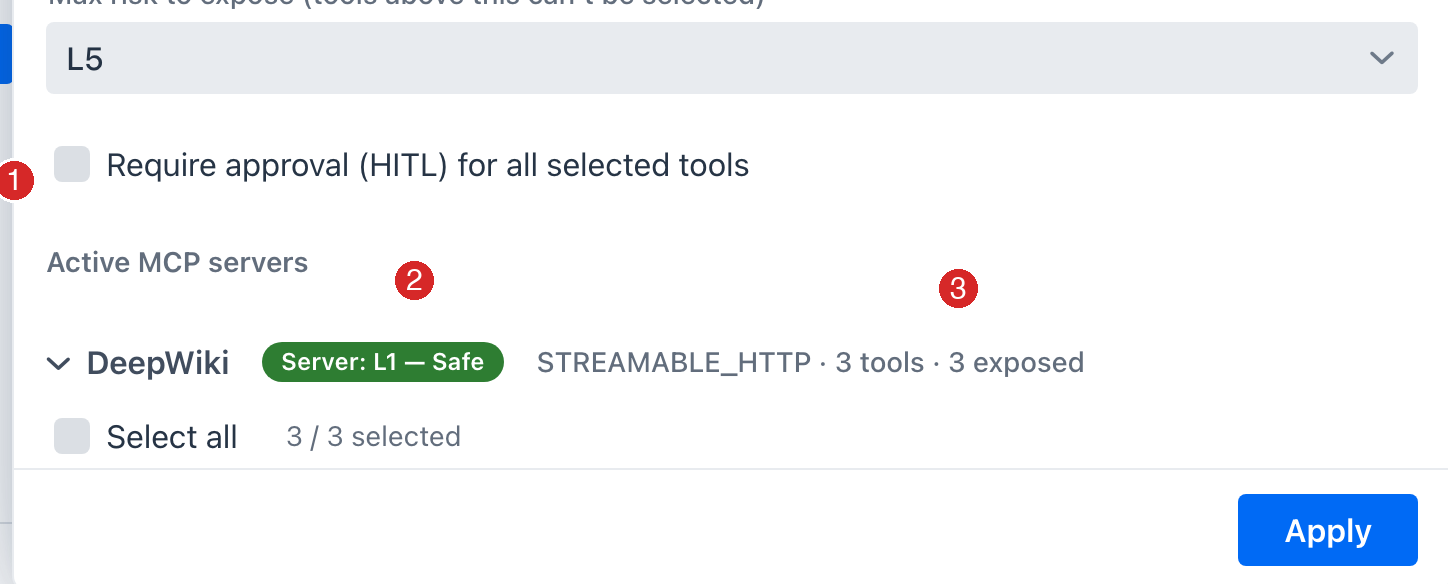
When an upstream tool is re-exposed on the built-in server, McpToolRiskComposer combines the two scores: if either side tripped a floor, the composed level is the higher of the two; otherwise the axis totals add and re-bucket. Marking the exposed tool HITL (require human approval) then lowers the effective level by one band (applyHitlMitigation, floored at L1) - a risk-accounting reflection that a human gates each call. The flag is persisted on the exposed member; the runtime approval gate itself is the MCP-elicitation checkpoint described in Human-in-the-Loop Approval, which honors the same flag.
The same mitigation applies to the built-in server's own tools: when a built-in tool's spec requires approval, McpToolRiskEvaluator reports an effective level one band below the inherent sandbox posture, and the Inspector chip shows both (L5 → L4). Two guards keep that credit honest - a description that trips the poisoning scanner forfeits it (a deceptive description would mislead the very human the credit assumes), and the runtime gate fails closed (a client that cannot answer the elicitation gets the call denied), so a credited mitigation can never silently no-op.
This is why exposing read_wiki_structure with HITL shows L1 - Safe with a HITL -1 annotation while its un-gated siblings stay L2 - Low:
The safe-wrapping contract
Re-exposing an upstream tool does not copy it - it wraps it in a WrappedExternalToolCallback. The wrapper is a thin, uniform safety envelope: whatever language or framework the upstream tool was built with, once wrapped it behaves like a first-class, governed tool on the built-in server. The upstream call itself is unchanged - but everything around it is now guaranteed:
| The wrapper adds | What it does |
|---|---|
| Re-identification | Publishes under the exposed alias and optional description override; the input schema passes through unchanged |
| Risk level | Carries the composed L0-L5 level (server + tool, HITL-mitigated) as a chip and a span tag |
| Logging & tracing | Emits mcp.tool.start / mcp.tool.done / mcp.tool.crash with call duration on every invocation |
| Risk MDC context | Pushes saip.cid, saip.tool.origin, saip.composition.*, saip.upstream.*, saip.risk.*, and saip.risk.floor_trigger for the duration of the call - so a chat tool call traces back to its upstream origin and computed risk (see Observability → MCP Servers) |
| Secret masking | Redacts upstream connection secrets from error messages before they reach logs or chat |
| HITL gate | Records the per-tool human-approval flag; the runtime elicitation gate honors it |
This is what makes "any-language MCP server → wrap → safe" concrete: a tool you did not author and cannot inspect becomes one that is identified, risk-rated, approval-gated, logged, traced, and secret-masked at the boundary - without touching the upstream implementation.
Tool-description poisoning scan
A tool description is attacker-controlled text that the model reads as instructions. McpToolPoisoningScanner scans every description for eight injection signatures (hidden-instruction, system-prompt override, role hijack, zero-width / RTL-override / homoglyph unicode, ANSI escapes, exfiltration directive); the ninth defined signature, a cross-server imperative, is enforced on the exposure path by the shadowing rules instead. A hit surfaces a poisoning warning chip on the tool in the MCP Inspector and the Composed Tools drawer, emits a PoisoningHit risk-signal event to the audit sink, and forfeits the tool's HITL mitigation credit, so a tampered description is visible - and scored at full inherent level - before you re-expose it. (The scanner exposes a shouldBlockPublish() helper, but the current runtime treats the scan as advisory for publish - it warns rather than hard-blocking.)
| Pattern | Catches |
|---|---|
HIDDEN_INSTRUCTION |
"ignore (all) previous/prior/above instructions" |
SYSTEM_PROMPT_OVERRIDE |
<system> / [system] / ChatML role-boundary markers |
ROLE_HIJACK |
"you are now / actually / really a ..." |
UNICODE_ZERO_WIDTH |
zero-width chars (U+200B/C/D, U+2060, U+FEFF) hiding text |
UNICODE_RTL_OVERRIDE |
right-to-left overrides (U+202A-202E, U+2066-2069) that reverse visible order |
UNICODE_HOMOGLYPH_RISK |
mixed Latin/Cyrillic look-alike characters |
ANSI_ESCAPE |
ANSI terminal escape sequences |
CROSS_SERVER_IMPERATIVE |
an imperative verb ("then call ...") naming another exposed tool within 80 chars |
EXFILTRATION_DIRECTIVE |
"exfiltrate / send to / post to / forward all" + an email or URL |
Tool fingerprint ledger - change detection
McpToolHashLedger stores a SHA-256 of each tool's canonical content (name + description + input schema; the live composition path does not include upstream annotations, so an annotation-only redefinition is a known blind spot). The content is serialized through one declared canonicalization - the same sorted-key, compact-JSON profile that CanonicalHasher uses for the authored-artifact integrity ledger - so the fingerprint no longer depends on JSON key order: a semantically identical tool whose input-schema keys arrive reordered stays UNCHANGED instead of tripping a false MISMATCH. Each fingerprint records that profile by name next to its digest (canonicalization: saip-jackson-sorted-sha256/v1), so a stored digest never depends on guessing which serialization produced it. A re-check returns NEW (first sight), UNCHANGED (hash matches), MISMATCH, or RECANONICALIZED. On MISMATCH a silently redefined upstream tool flips the fingerprint status to AWAITING_REREVIEW and emits HashLedgerMismatch, so a "rug-pull" redefinition cannot ride in on a prior approval. RECANONICALIZED means the stored fingerprint was taken under a different profile, so the two digests are not comparable: the ledger re-baselines under the current profile, keeps the existing lifecycle status (a pending AWAITING_REREVIEW stays pending), and emits HashLedgerRecanonicalized rather than a tamper signal. Fingerprints written before the profile was recorded are stamped with it on their next matching check. Fingerprint lifecycle states are ACTIVE / AWAITING_REREVIEW / REVOKED (the last reserved - the live path sets only the first two).
Composition shadowing rules
Before a composition is enabled, McpCompositionShadowingRules checks three rules; any violation refuses the enable:
R1_ALIAS_COLLISION- the same exposed alias is claimed by more than one enabled composition (ambiguous tool resolution).R2_CROSS_SERVER_REFERENCE- a member's description imperatively references another member's tool name/alias (cross-server prompt injection).R3_SELF_SCOPE_VIOLATION- a member's description names another member's server id (scope/architecture leak).
Where it surfaces
| Surface | What the chip/scan shows | Page |
|---|---|---|
| Connection form | Live server risk chip as you type / pick an entry | MCP Server → Connection risk preview |
| Composed Tools drawer | Per-server + per-tool chips, max-risk cap, HITL -1 |
MCP Server → Expose external tools |
| Inspector Tools tab | Per-tool risk chip beside each tool card | MCP Inspector → Tools |
| Observability | saip.risk.* / saip.composition.* span tags |
Observability → MCP Servers |
Further reading
- AI Agent Tool Safety - the sandbox that contains locally-authored JS tools (the inward counterpart to this page)
- MCP Server feature guide - the screens this model drives
- Default MCP Servers → How catalog trust feeds the risk score
- AI Agent Observability - how risk-tagged tool calls become auditable