Tutorial 11 - Approve a Tool in Chat
Time 6 min · Difficulty ★★☆ · Surfaces Tool Studio, Agentic Chat
Goal
Require approval on a tool, then watch Agentic Chat pause and ask you before it runs - and see what happens when you decline.
This is the runtime half of the safety story: the sandbox and risk model decide what a tool may do; human-in-the-loop (HITL) decides whether this call runs at all. See the feature page and architecture for the full picture.
Prerequisites:
- A published tool you can call from chat - the one from Tutorial 1 - Author a Tool is perfect. Any tool works.
- A chat model configured in Agentic Chat (see Tutorial 4 - Chat with Tools).
1. Require approval on the tool
- Open Tool Studio and select your tool.
- Expand Sandbox & Capabilities.
- Under Human-in-the-loop, choose Required - ask every run.
- (Optional) Set an Approval prompt such as
About to run '{toolName}' with {args}. Proceed?-{toolName}and{args}are filled in at call time. - Click Test & Update to save.
Above L0, this may already be on
A tool above risk L0 defaults to Required the moment you author it. If it's already set, just confirm the mode and move on.
2. Make the tool reachable from chat
Agentic Chat reaches your published tools through the built-in MCP server.
- Open Agentic Chat.
- In the tool menu above the prompt, tick Manual built-in tool selection.
- Pick your tool. A shipped catalog tool (like
getWeather) is in Built-in tools for this chat; one you authored yourself is a custom tool and sits in the Custom tools for this chat picker above it.
3. Trigger the tool and approve
Ask the agent to do the thing your tool does - for example, "Use the tool to get me the current time."
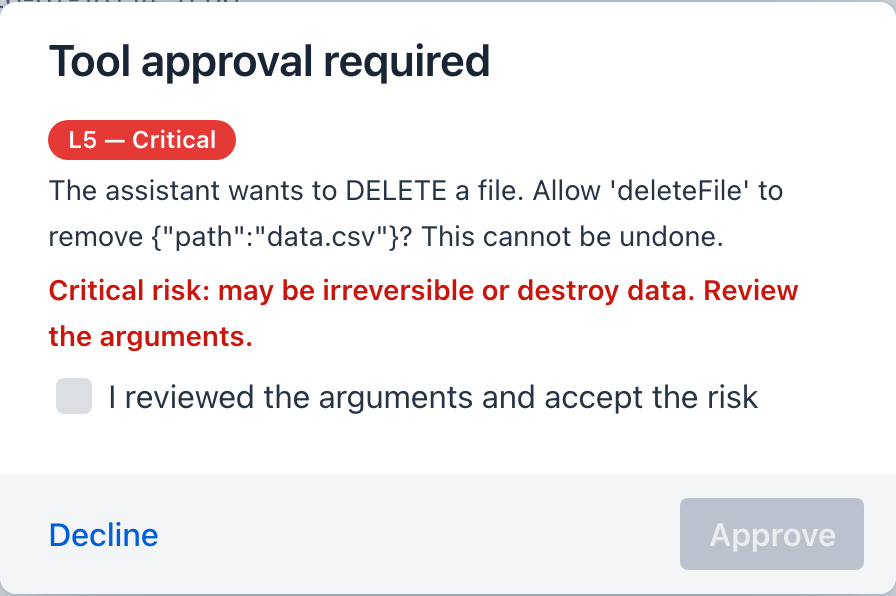
When the model decides to call the gated tool, chat stops and a dialog appears:
- Title: Tool approval required
- A colored risk-level chip (L0-L5) for the tool being called - hover it for the rationale
- Body: your approval prompt, with the real tool name and arguments
- Buttons: Approve and Decline
Click Approve. The tool runs, its result returns to the model, and the answer streams in as usual.
Inspect the arguments before you approve
The dialog shows the exact arguments the model chose. This is your chance to catch a wrong path, a bad amount, or an unintended recipient before the call fires.
The dialog escalates with the tool's risk level: at L4 (High) the line High risk: can modify files, spend money, or change external state. appears and Approve turns red; at L5 (Critical) - the filesystem delete and move tools, for example - the line reads Critical risk: may be irreversible or destroy data. Review the arguments. and Approve stays disabled until you tick "I reviewed the arguments and accept the risk". Try it with deleteFile from the filesystem tools to see the full escalation:
4. Try declining
Ask again, but this time click Decline.
The tool does not run. Instead the model is told you declined approval and that it should not retry - so it either finds another way or replies that the action couldn't be completed because you declined. Nothing executed; the decline is recorded in the run.
Approval fails safe
If you don't answer within two minutes (the agent-loop.approval-timeout-seconds setting), the call times out and does not run: the model is told the approval is still pending, so it replies that the action is waiting on you and that you can send the request again. The Safety dashboard counts it as a timeout, separate from a decline. A gated tool only runs on an explicit Approve.
What you learned
- Set a tool's Human-in-the-loop mode to Required in Tool Studio.
- Agentic Chat pauses on a gated call and asks you to Approve or Decline.
- Decline (and timeout) block the call and tell the model - execution is deny-by-default.
- When one round gates several calls at once, the dialog batches them: the header becomes Tool approvals required, each call gets its own Approve/Decline radio group, and a single Confirm applies your choices - with the same acknowledgement checkbox if any of them is
L5.
Next steps
- Re-expose an external tool with approval: Tutorial 10 - Proxy an MCP Server + the HITL column.
- Understand the two gates and loopback de-duplication: Human-in-the-Loop architecture.